'%3e%3cg%20id='g214'%20transform='matrix(0.32183751,0,0,0.32183751,430.83572,150.72677)'%3e%3cg%20id='g216'%20clip-path='url(%23clipPath220)'%3e%3cg%20id='g222'%20transform='translate(1045.0996,889.4355)'%3e%3cpath%20d='m%200,0%20v%20-99.952%20l%2077.659,45.514%20V%2052.936%20C%2074.122,52.956%2070.734,52.744%2067.494,52.334%2041.653,49.034%209.569,27.182%200,0%20M%20-77.658,367.348%20V%20180.333%20c%2031.278,17.938%2068.013,23.603%20100.61,10.753%20C%2053.247,179.142%2079.118,153.56%2077.659,118.917%2047.852,119.264%2017.295,109.79%200,91.721%20v%2045.051%20L%20-77.658,91.258%20V%20-88.106%20l%20-77.661,-45.515%20v%20455.453%20z'%20style='fill:%2321303b;fill-opacity:1;fill-rule:evenodd;stroke:none'%20id='path224'%20/%3e%3c/g%3e%3c/g%3e%3c/g%3e%3c/g%3e%3c/svg%3e)
Benefits of Practicing Rural Medicine
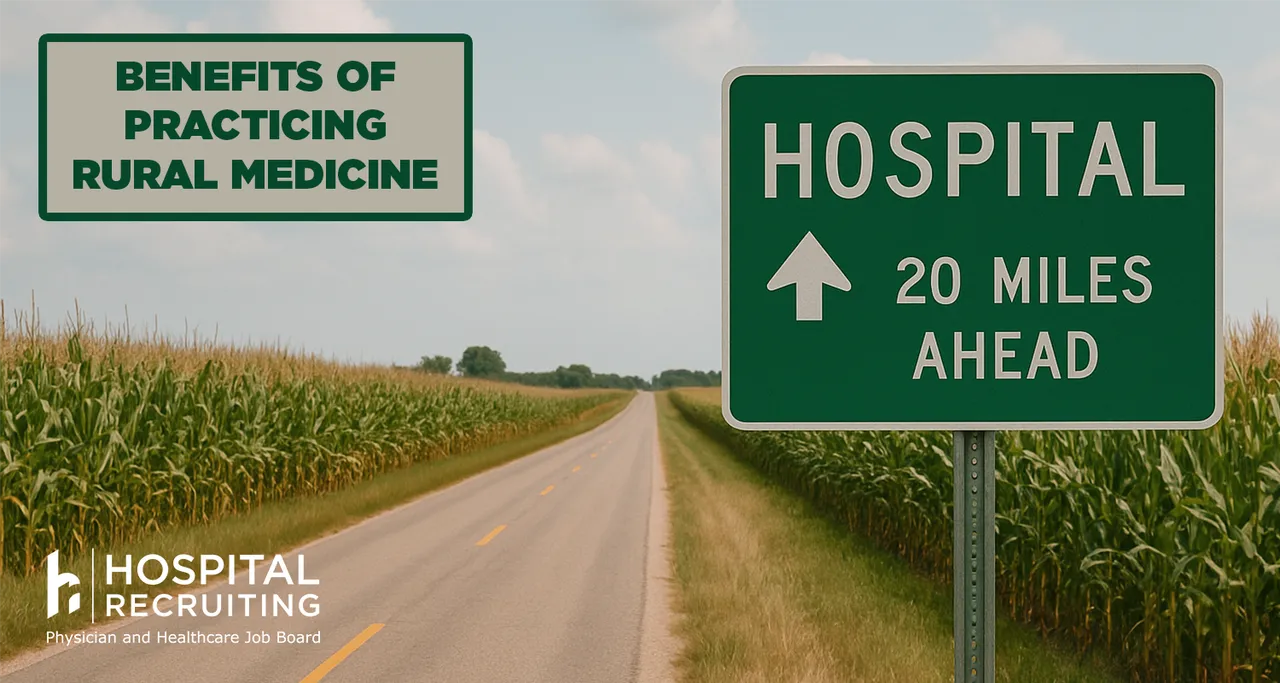
Rural settings are underrated healthcare experiences. I think a lot of physicians hear “rural” and focus on only the stereotypes of resource poverty, long travel or low pay. Having worked in both rural and urban sites for over a decade, I’d like to offer a few unsung advantages to rural sites that are worth considering.
You get to be the doctor
In rural settings, it’s often just you. You are either the only physician or one of few physicians available. There is no left pinky surgeon on call – it’s you. You work at the top of your license and figure out the best possible scenario for patients. Your work becomes a test of knowledge, skills and ability. As a result, you will develop greater bedside acumen and procedural competency.
If you work in a receiving facility, consider the patients you’ve received from rural hospitals: critically ill or injured patients who receive the best available care despite a lack of definitive specialists or equipment. Consider the physicians who cared for that patient prior to transfer. They were on an island, doing the best possible work they could with the resources they have.
As daunting as that sounds, when you work in rural medicine, you will wear these experiences as badges of honor. You will hone your abilities and develop a professional confidence that you may not have had in a more resource-abundant setting.
Fantastic patient population
As a group, the patients in rural healthcare are hardworking, genuine, straightforward people. If you want to care for farmers, industrial workers, and day laborers — people who make up the nation’s backbone, then consider working in rural healthcare. Many of these patients don’t come to the hospital unless they perceive something is actually wrong, and they often do so much later than they should.
It’s understood that there are patients with difficult personalities all over the world, but patients in rural environments tend to be much more grateful and well-mannered. I’ve never heard so many sirs, ma’ams, pleases, and thank you's as I do in a rural setting.
As rural settings can be slower paced, the actual time spent at the bedside is also quite rewarding. You have greater likelihood of sitting with a patient, explaining what is going on, and making a plan that works for all involved. When I’ve asked patients to return the next day for a wound check, they do it. When a patient can’t stay to be admitted, I actually see them come back the next day to be checked on.
It’s a refreshing and welcome change.
Your co-workers are more like family
This is true in many settings, rural or otherwise, but in a rural setting, the number of people you work with is much smaller. It’s the same few colleagues every time you work. You’re on a first name basis and you’re told when a fresh pot of coffee has been brewed.
It’s been in rural settings that I’ve seen nurses bring in crock pots of food “just because,” drop off a box of extra oranges they grew, or bring a dozen eggs from their chickens. It’s a close-knit, familial dynamic that is pleasant to be welcomed into.
You’ll also find that the people who work in rural settings can’t see themselves working anywhere else. They’re called to work in an underserved area and take ownership of the patients they serve. It’s a personal experience and a welcome change from the feeling of being “just another doctor” in a massive organization.
Your skills are needed and appreciated
Rural healthcare is underserved healthcare. The barriers to access experienced everywhere disproportionally affect the rural setting. For patients, the cost of traveling to see a physician, the availability of personnel, equipment, or treatments mean that healthcare will not be sought or sought much too late.
You are very much needed in the rural environment. Though your skills are needed everywhere, the need is much more tangible in a rural setting. You will get the sense that people are consciously aware of the need more than those who are in an urban setting.
Just as you will undoubtedly develop a respect for the patients you serve and the teams you work with, there is a palpable respect for the skills you are bringing. This mutual appreciation might be a welcome change.
Secret bonus: Nights can be glorious
Working nights is a necessary evil no one wants to endure. However, rural settings are often lower patient volume settings, and low volume settings become even lower volume settings at night. While you can certainly have busy or high acuity nights, you will have significantly slower, easier nights than you will ever have in an urban setting — nights where a new patient only shows up every few hours or where there is only one admission the entire night. Even nights where no one comes in for hours, or not at all. If you’re in a specialty where you must work nights or take night call, consider working in a rural setting — you might as well get paid to have a few easier nights in your life!
**Editor's Note: Rural medicine is only one practice locale to consider. For more information on urban medicine practices, visit our companion piece here.**
Related Posts