How Emerging Technologies Are Shaping the Future of Healthcare
Philip Ezze [CC BY-SA 4.0], via Wikimedia Commons

Imagine a world where complex health issues can be solved or prevented with relative ease. As lifespan increases, technology innovators race to outpace the growing demands of the planet’s expanding population. Medical technology companies create faster, more, and less expensive answers to patient care needs. Engineering and science have converged, making medical practice easier for physicians, more effective for patients, and less costly to the system struggling to hold it all up.
With increased life expectancy comes the inevitable increase in all age-related maladies such as dementia, heart disease, lung conditions, cancer, and stroke. Novel technologies will provide the answer to early detection, rapid treatment, and improved recovery.
Below are a few examples of how innovative thinking has already impacted healthcare. This article provides just a taste of the incredible emerging technologies shaping the future of healthcare.
Speak Up Please
Neurologic conditions frequently rob patients of the ability to speak. Researchers have demonstrated the ability to restore this relevant part of human existence by harnessing brain activity and producing synthesized speech. Researchers at the University of California, San Francisco, implanted brain electrodes into volunteers and subsequently were able to decode the neurologic signals. These signals were used to create a computer-generated version of the volunteers' vocal tract and produce speech using a synthesizer.
While researchers admit further work needs to be done to make speech crisper and less slurred, their work offers hope to stroke, Parkinson's, MS, and ALS patients.
Along the lines of communication, researchers have developed hearing aids that can pick out specific voices in a crowd. Traditional hearing aids amplify all voices (cocktail party effect), making communication challenging. A novel brain controlled hearing aid utilizes AI to separate voices and then detects brain activity to enhance one voice and deliver an amplified sound to the hearing aid user. The device can also detect when the user switches attention to a different voice and selectively amplifies that speaker's voice, greatly enhancing the ability to converse in a group setting.
Power Up
One of the biggest challenges facing device manufactures is battery life. It is estimated that nearly a billion batteries will need to be changed every day to sustain the current trillion-plus sensors being worn globally.
A new alternative was created at Michigan State University, allowing alternative energy storage that doesn't rely on batteries. Researchers developed highly stretchable supercapacitors using carbon nanotubes. These tubes are comprised of nanomaterial with excellent electronic and mechanical properties that allow wearable devices to conform to body contour and movement. The promise is that the nanotubes will hold more energy per charge.
You can learn more about this novel technology by searching for crumpled carbon nanotube forests, or CNT forests.
Thinking Differently
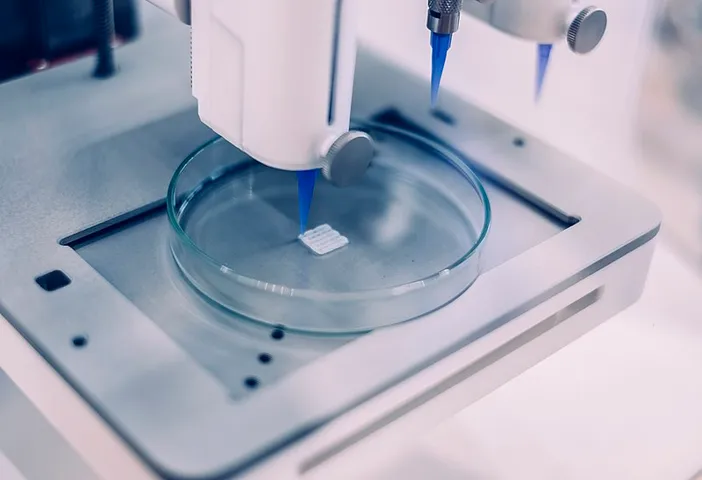
While 3D printing is not new, novel thinking has created innovative possibilities to address much of what ails us as a species.
The customization created by 3D printing delivers back braces, Invisalign retainers to straighten teeth, and hearing aids. A father even borrowed a 3D printer to create a prosthetic for his son. Align Technologies prints over 650,000 sets of teeth-straightening retainers a day.
In the US alone, over 100,000 people are stuck playing the waiting game, trying to survive long enough to receive an organ transplant. 3D bioprinting has the potential to solve this scarcity problem. Medical innovators have already 3D printed a beating heart.
One of the initial challenges was creating the scaffolding of blood vessels necessary to replicate human organs. Researchers created a version of stereolithography (SLA) and created a network of capillaries in a cell-filled hydrogel, allowing precise control of how vessels form. In short, they were able to create functioning blood vessels. Similar technology can be used to create air sacks similar to alveoli (found in lung tissues) and use a printed network of vessels to transfer oxygen to deoxygenated red blood cells.
The pharmaceutical crowd is also exploring how 3D printing can impact drug delivery. Potential uses include personalized drug dosing, unique and customizable dosage forms, and more complex pharmacokinetic release profiles.
As techniques continue to be developed and refined, virtually every area of medicine will be impacted by 3D printing.
Blockchain
Creation, storage, and transfer of medical information is a massive undertaking. Add in the avalanche of data from the growing use of wearable medical devices, and it's clear there are problems at several levels — layer on top, the complexities of insurance plans, payments, and middlemen, and it's easy to get lost.
One potential solution is the blockchain.
Although much more complicated, here is a simple explanation:
The blockchain is a system that records a transaction made in bitcoin, or another cryptocurrency maintained across several computers that are linked in a peer-to-peer network. The technology allows digital information to be distributed, but not copied.
As a consultant with Healthcombix, I asked our CEO, Cyrus Maaghul, to share a few thoughts on how the blockchain will positively impact the health insurance realm:
"Healthcombix vision is to build digital health insurance communities. Healthcare insurance companies do two things 1) pool money and 2) and coordinate care.
Blockchain technology enables groups (think digital health community or cooperatives) to come together for a common purpose without a central administrator. This significantly reduces coordination costs when scaling.
Blockchains also facilitate the direct movement of value between marketplace participants utilizing tokens or cryptocurrency with no bank or insurance company required in the middle. This is a powerful capability. Trust not requiring a third party.
When you look at how health care insurance companies operate, the core of their business is trust, pooling consumers’ insurance premiums, paying claims, and coordinating care. We entrust them with our money and governments regulate them to prevent intentional and unintentional malfeasance.
That regulation comes at a cost in varying flavors in developed, corrupt, and surveillance economies. This cost is passed on to the consumer or insured one way or the other."
Blockchain and its associated currencies will permanently alter the way the business of healthcare is conducted.
Deep Brain Stimulation and Opioid Addiction
DBS or deep brain stimulation has been used for movement disorders such as Parkinson's for years. Recently, doctors in China have discovered promising results in treating opioid-addicted patients. Opioid addiction affects millions, and according to the National Institutes on Drug Abuse, over 130 people die every day in the United States die after overdosing on opioids.
Although the original study numbers are small, the majority of patients in this study at Shanghai's Ruijin Hospital have abstained from heroin for at least two years. Worldwide, eight clinical trials utilizing DBS and addiction are ongoing. The opioid issue is complex, but DBS has demonstrated clear promise in this realm.
Brain-Machine Interfaces
Teams at the Defense Advanced Research Projects Agency (DARPA) are pioneering nonsurgical communication between computers and the brain.
In anticipation of the future, this technology will assist humans in managing tasks that occur too fast for our brains to efficiently or effectively manage. Aside from battlefield or military use, advances utilizing this technology have already changed lives.
A familiar example of this concept is the LUKE Arm system that provides dexterity to an artificial hand and arm. The FDA approved this system after years of testing in collaboration with the Department of Veterans Affairs.
The HAPTIX (hand proprioception and touch interfaces) program is designed to restore intuitive touch and feel by connecting with motor and sensory nerves. An added benefit is the reduction in the commonly experienced phantom limb pain in amputees.
Several teams are working on different methods including use of nanotransducers to convert neuronal electrical signals into magnetic signals. After processing by a machine (computer), bidirectional communication will be possible, exponentially expanding the human brain, essentially creating a superhuman. The result will be a wearable device capable of interfacing with the brain from just a few millimeters away.
Many lives will be impacted as this type of technology advances and the cost decreases, improving access to those affected by amputation and paralysis.
TeleMedicine
The practice of telemedicine has impacted medicine over the last decade, but many patients and practitioners are still in the dark.
While early use focused on simple care issues such as the common cold, bladder infections, and sore throats, current usage has evolved significantly. Research continues to show improved outcomes and cost savings when telemedicine is appropriately utilized.
Recent studies show lower re-admission rates for patients with COPD exacerbations.
Medical schools have incorporated telemedicine into their student curriculum, as it will be an integral part of medical practice going forward. Training students early gives them the comfort and confidence to rely on this tool to provide care across distances, allowing patients to remain comfortable where they are without having to drive to a clinic, depending on the circumstances.
With the growing use of wearable sensors, more complex conditions can be managed at home, and early detection of problems has the potential to improve health and save lives. A simple example is Apple's foray into the cardiology arena with the capability of the Apple watch to detect atrial fibrillation.
Unfortunately, the current landscape of healthcare focuses on the treatment of chronic diseases. Wireless technologies will play a vital role in early detection of warning signs and will aid in the prevention of many of the chronic diseases plaguing modern society. Combined with genetic testing, personalized medicine, and wearable device data, clinicians will have an understanding of the individual patient like never before.
More AI Proof
Lung cancer is a massive problem on a global scale, claiming twice as many lives as breast cancer.
Human doctors are not infallible, and Google's AI system demonstrated its proficiency in detecting human lung cancer. In fact, it outperformed six expert radiologists by 5%. In a study analyzing 42,000 CT scans, Google's deep learning model decreased false positives by 11%. Imagine the impact on those patients' lives and a reduced risk of invasive procedures as a result of this AI system.
Deep learning is being applied to various disease processes, including diabetic retinopathy and has been touted to be able to recommend proper treatment of fifty eye conditions with a 94% accuracy rate.
The expanding use of AI will enhance the delivery of healthcare in ways not previously imaginable. Google is leading the charge in this realm, and the future of medicine has never been more exciting or promising.
Conclusion
Keeping pace with evolving technologies is daunting. Exponential mindsets and moonshot thinkers are making great strides in confronting the terminal human condition. Countless lives owe a debt of gratitude to these pioneers.
Further Reading:
https://msutoday.msu.edu/news/2019/self-powered-wearable-tech/
https://www.darpa.mil/program/revolutionizing-prosthetics
https://www.darpa.mil/program/hand-proprioception-and-touch-interfaces
https://www.darpa.mil/program/systems-based-neurotechnology-for-emerging-therapies
https://3dprint.com/205401/father-and-son-prosthetic-hand/
https://venturebeat.com/2019/05/20/googles-lung-cancer-detection-ai-outperforms-6-human-radiologists
https://spectrum.ieee.org/the-human-os/biomedical/bionics/darpa-funds-ambitious-neurotech-program
Related Posts